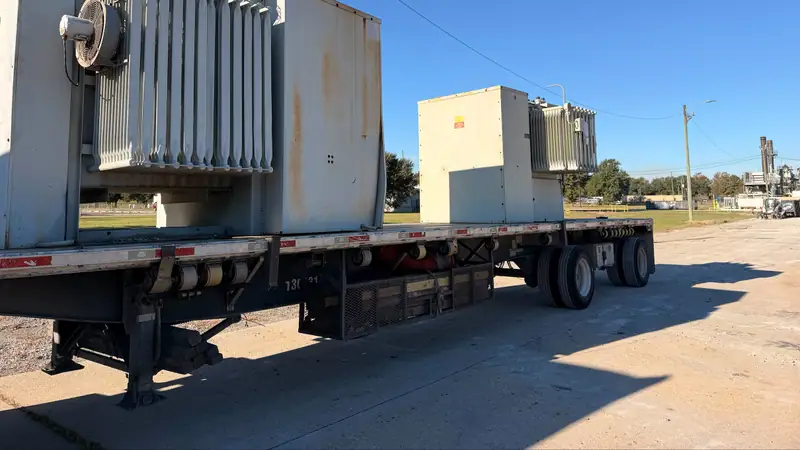
Transformer Weight by kVA: Approximate Planning Ranges
These approximate ranges are useful for an early pickup discussion, not for selecting a forklift, crane or lifting accessories. They represent common three-phase enclosed dry-type and liquid-filled distribution transformers. Pole-mount, cast-coil, network and specialty designs can have substantially different weights.
| Transformer rating | Enclosed dry-type, approximate weight | Liquid-filled, approximate weight |
|---|---|---|
| 75 kVA | 600–1,400 lb | 700–2,000 lb |
| 150 kVA | 1,000–2,500 lb | 1,200–3,000 lb |
| 500 kVA | 2,500–5,000 lb | 3,000–7,000 lb |
| 1,000 kVA | 4,500–9,000 lb | 5,000–11,000 lb |
| 2,500 kVA | 9,000–18,000 lb | 10,000–24,000 lb |
Use the nameplate total weight rather than these ranges for lifting and transportation planning. If the plate does not show weight, send the manufacturer, model and serial number so the equipment team can seek reliable documentation before loading.
Our transformer size guide explains capacity ratings. kVA describes electrical capacity, not shipping weight: two units with the same rating can require different loading arrangements.
Why Two 500 kVA Transformers Can Weigh Differently
The weight of a 500 kVA transformer depends on more than its output rating. Winding material, voltage class, enclosure construction, cooling design and accessories all contribute. A higher-voltage design may need different insulation and spacing, while a liquid-filled unit includes the tank, insulating fluid and external cooling equipment.
For oil-filled transformers, ask whether a listed weight includes the fluid and all installed accessories. Mineral oil, natural ester and silicone designs should be identified accurately rather than treated as interchangeable shipping configurations. For dry-type units, confirm whether the enclosure is included in the stated weight.
Total weight also tells us little about the amount of recoverable copper. Steel, fluid, insulation and other materials contribute to the load, and some transformers have aluminum windings. Our guide to copper in a transformer explains that distinction.
Send the actual configuration as it sits today. Missing radiators, a removed enclosure or a separate crate can change both the load weight and the number of pieces we need to collect.
Find the Total Weight and Document the Pickup Load
Look for a nameplate entry marked “total weight,” “weight” or “shipping weight,” then photograph the entire plate clearly. Check the units: pounds and kilograms are not interchangeable. Some plates separately list core-and-coil weight, fluid quantity or untanking weight; those figures are not a substitute for the complete pickup load.
Our guide to reading a transformer nameplate helps identify the electrical and construction details we review. Along with the plate, send:
- Overall length, width and height, including attached radiators or projections.
- Photos of the base, lifting provisions and all sides of the unit.
- The number of transformers and any separately packed components.
- Condition, fluid type and PCB status, plus test data if available.
- Whether the unit is installed, disconnected, crated or already staged for loading.
If a new surplus unit is still crated, include the crate dimensions and any marked gross shipping weight. Packaging adds to the load and may hide the lifting points. Our transformer photo checklist helps you capture useful details without opening electrical compartments.
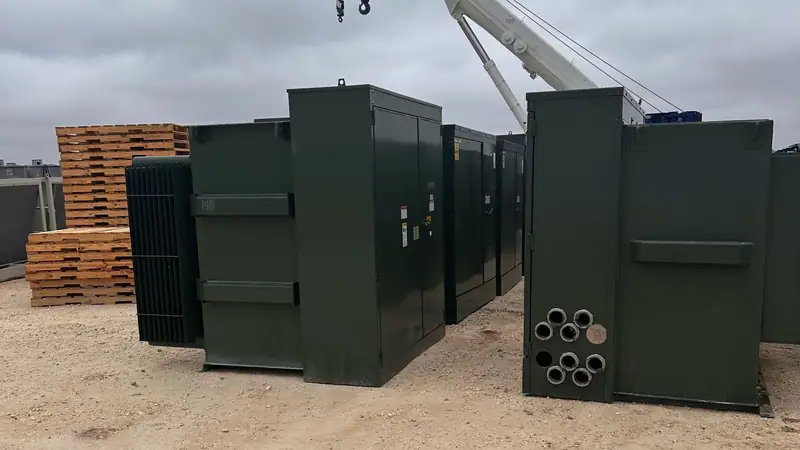
Choosing a Forklift or Crane for Transformer Pickup
Weight is only one part of choosing lifting equipment. A forklift’s usable capacity depends on the load center, lift height, attachments and the machine’s capacity chart. A transformer’s size and center of gravity can make it unsuitable for a forklift that appears large enough based on weight alone.
We coordinate forklift, rigging or crane arrangements according to the unit and site. Send photos showing the loading surface, approach route, overhead obstructions and the space around the transformer. Tell us about gravel, slopes, soft ground, curbs or basement locations before equipment is scheduled.
A crane may be needed when a truck cannot reach the unit or when the load must be lifted across an obstruction. Crane planning considers the lifting radius, setup space, ground support and the manufacturer’s designated lifting provisions—not just the transformer’s weight.
Transformers must be safely isolated and disconnected by qualified personnel before removal. Do not lift from bushings, radiators or unverified attachment points. If you prefer to load with your own equipment, let us know during the pickup planning process so responsibilities are agreed in advance.
Flatbed, Step-Deck and Lowboy Planning in New York
We coordinate flatbed, step-deck or lowboy trucking based on the transformer’s weight, dimensions and loading method. A flatbed may suit a load that fits within the planned route’s height limits. A step-deck or lowboy can provide a lower deck when overall loaded height is a concern, subject to the trailer’s capacity and configuration.
The truck decision also depends on where it can park and turn. Send the gate width, driveway layout and any restrictions on staging or delivery hours. For tight urban sites, include photos of the street approach and the space available for loading equipment.
New York heavy-load planning involves gross vehicle weight, axle loading, loaded dimensions, bridge restrictions and the proposed route. Oversize or overweight movements may require permits and route review; confirm current state and local requirements with the hauling provider before scheduling.
We arrange pickups across our New York service area, but we do not have a public storefront or drop-off yard in the state. We come to the seller and plan transportation around the actual load and location.
Send the Details We Need to Plan Your Pickup
Call or text 951-403-5738, or request a written offer with nameplate photos and basic details. We review the type, kVA, voltages, age, condition, fluid and PCB status, along with test data if available. We buy new surplus, used, removed-from-service, decommissioned, damaged and scrap transformers, from one unit to an entire yard.
For pickup planning, identify the site contact and tell us who controls access to the equipment. A transformer on your property may belong to a utility; utility-owned equipment is not yours to sell. Confirm ownership before requesting an offer or arranging removal.
After we provide a written offer and agree on terms, we schedule pickup and coordinate the loading equipment and truck, or work with your loading crew if you prefer. A quick inspection at pickup confirms that the transformer matches the submitted photos and details.
Payment is by check, ACH or wire under the agreed terms. Clear weight information and site photos help us plan the collection correctly; an estimated kVA-based weight alone is not enough to finalize the lift.
Questions sellers ask about Transformer Weights by kVA
How much does a transformer weigh?
Transformer weight varies with capacity, voltage, construction, enclosure and fluid content. A small distribution transformer and a large power transformer require very different handling equipment. Use approximate ranges only for an initial discussion, then rely on the nameplate total weight or verified manufacturer documentation for lifting and trucking.
What is the weight of a 500 kVA transformer?
As a broad planning estimate, a three-phase enclosed dry-type 500 kVA transformer may weigh approximately 2,500–5,000 pounds, while a liquid-filled unit may weigh approximately 3,000–7,000 pounds. Individual models can fall outside those ranges. Send the nameplate total weight, dimensions and photos before selecting loading equipment.
Can I use a forklift to load a transformer?
Possibly, but the transformer’s weight alone does not determine suitability. The forklift’s capacity at the actual load center and lift height, the transformer’s base and lifting provisions, and the ground conditions all matter. Send us the unit details and site photos so the loading team can assess the arrangement.
Does transformer nameplate weight include the oil?
Check the wording on the plate and the manufacturer’s documentation. Total weight, shipping weight, core-and-coil weight and fluid quantity describe different things. Confirm that the stated weight covers the complete unit in its current condition, including fluid and attached components. Do not drain fluid simply to reduce pickup weight.