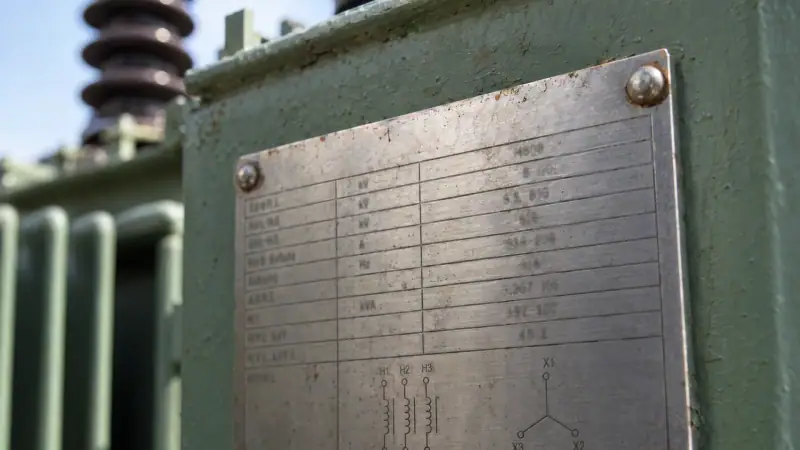
Transformer nameplate basics: kVA, phase and frequency
Start with the manufacturer, model or type designation, and rated capacity. A rating in kVA describes apparent power, not the transformer's weight or its actual operating load. Larger power transformers may show capacity in MVA; one MVA equals 1,000 kVA.
We look at these three fields together:
- kVA or MVA: The rated capacity under the stated operating and cooling conditions. Multiple ratings may correspond to different cooling stages.
- Phase: Single-phase or three-phase. On a three-phase unit, the listed kVA generally represents the entire transformer, not each phase.
- Frequency: Usually 60 Hz for equipment serving US power systems. Photograph a 50 Hz or dual-frequency marking exactly as shown.
Our standard transformer sizes guide helps explain common capacity ratings, but send the exact value from your plate rather than rounding it to a familiar size. If rated current is listed, include it too. You can use our kVA-to-amps calculator to understand the relationship between capacity, voltage and phase; it is not a substitute for the manufacturer's ratings.
Read HV/LV voltages, tap settings and connection diagrams
HV means the higher-voltage winding, and LV means the lower-voltage winding. Those labels do not always mean input and output: a step-up transformer receives power on its lower-voltage side. Record every voltage shown, including any alternate winding connections.
A marking such as 480Y/277 identifies a wye system with 480 volts line-to-line and 277 volts line-to-neutral. A slash separating two selectable voltage ratings can mean something different, so we read it alongside the connection diagram rather than treating every slash alike.
Tap markings show available winding adjustments. Send the full tap table and, if safely visible, the indicated position. An off-circuit tap changer must not be operated while energized; operational changes belong with qualified electrical personnel following manufacturer instructions.
The connection diagram identifies winding connections and terminal markings, commonly H terminals for the higher-voltage winding and X terminals for the lower-voltage winding. It may also show a neutral terminal, grounding provisions or reconnectable windings.
A vector group, often found on IEC-style plates, describes winding configuration and phase displacement. Letters identify connections such as delta or wye, while the clock number indicates displacement in 30-degree increments. Photograph the complete code and diagram so we can review them together.
Check impedance, BIL, temperature rise and cooling class
These fields describe operating characteristics that voltage and capacity alone do not capture. We use them when comparing a unit with potential reuse requirements.
- Impedance, or %Z: Percentage impedance affects voltage regulation and available fault current. Preserve any stated rating base or reference temperature when copying this value.
- BIL: Basic impulse insulation level describes an insulation system's impulse withstand rating, usually expressed in kV. It is not the normal operating voltage; separate winding or terminal ratings may appear.
- Temperature rise: The rated temperature increase above the specified ambient conditions. Dry-type plates may also list insulation class, which is a separate characteristic.
- Cooling class: The method used to move heat out of the windings and, for liquid-filled units, through the insulating liquid and surrounding air.
Common liquid-filled codes include ONAN for natural oil and air circulation and ONAF for natural oil circulation with forced-air cooling. Older plates may use OA and FA terminology. Dry-type plates may use AA, AN or AF markings, depending on the labeling standard and design.
If several kVA or MVA ratings appear beside cooling codes, send all of them. Tell us whether the fans and associated controls are present; an increased forced-air rating depends on the specified cooling equipment.
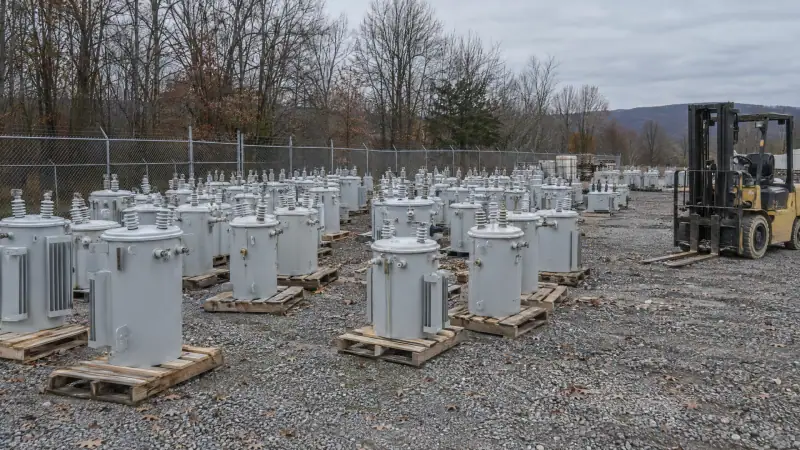
Identify insulating fluid, gallons and PCB statements
For a liquid-filled transformer, look for the insulating fluid type and quantity. The plate may identify mineral oil, natural ester such as FR3, or silicone. Copy the stated gallons or liters and photograph any separate fluid label, especially if the unit was retrofilled after manufacture.
We review oil-filled transformers using the plate information together with the seller's condition details. Nameplate fluid quantity describes the listed fill, not necessarily the amount currently inside a drained or leaking unit. Tell us about known leaks, draining or fluid replacement.
PCB information may appear on the main plate, a separate label or a laboratory report. Send the exact wording, including any concentration, test date and sample identification. Do not infer PCB status from the manufacturing year or fluid brand alone; our PCB testing and labels guide explains what documentation to gather. Confirm current handling and disposal requirements with the appropriate professionals or agencies.
If available, include fluid test reports and dissolved gas analysis. Our oil testing and DGA guide explains these records; they supplement the nameplate rather than replace it.
Separate total weight from component weights and unit identity
Transformer nameplate data may include several weights. Before planning removal, identify whether each figure is in pounds or kilograms and whether it describes the complete assembly or a component.
- Core and coil: The active assembly inside the tank or enclosure, not a measurement of recoverable copper.
- Tank and fittings: The tank and the fittings included under the manufacturer's stated breakdown.
- Fluid weight: The listed weight of the insulating liquid, distinct from its volume in gallons or liters.
- Total weight: The manufacturer's stated complete-unit weight under the configuration described on the plate.
Do not add component weights to a listed total. Check whether radiators, bushings, fans or other accessories are included, and tell us which parts have been removed. Our transformer weight guide provides approximate context, but we rely on the plate and confirmed equipment details for pickup planning.
Also capture the serial number, manufacturing year and model or catalog number. A patent date, drawing date or inspection sticker is not necessarily the manufacturing year. If the unit has been rebuilt, send both the original plate and any replacement or repair plate.
Send readable nameplate photos for a written purchase offer
You do not need to decode every abbreviation before contacting us. We can review clear photographs of the complete plate and ask for missing details. Take photos only from a safe, authorized position; do not open energized compartments to reach a label.
For a useful submission, send:
- One straight-on photo showing the entire nameplate, plus close-ups of small text.
- Separate photos of connection diagrams, tap tables, fluid labels and PCB documentation.
- Overall views showing the transformer, bushings, enclosure, radiators and any damage.
- Its New York location, operating or removal status, and available test records.
- Pickup details, including access restrictions and whether you can load the unit.
Use our online offer form or call or text 951-403-5738. We buy new surplus, used, removed-from-service, decommissioned, damaged and scrap transformers, from one unit to an entire yard. Utility-owned transformers belong to the utility and are not for sale by property owners.
After review, we provide a written offer and coordinate pickup from your location; we have no public New York drop-off yard. Our buying process explains rigging and trucking coordination, the pickup inspection to confirm the unit matches the photos, and payment by check, ACH or wire under the agreed terms.
Questions sellers ask about Reading a Nameplate
How do I read a transformer nameplate if it is faded?
Start with a full photo, then take close-ups from different angles to reduce glare. Send any readable manufacturer, serial number, kVA and voltage information, along with photos of separate labels. Avoid scraping or using chemicals that could erase markings. We can review partial information and tell you what else we need.
What does kVA mean on a transformer nameplate?
kVA means kilovolt-amperes, a measure of apparent power capacity. It is not the same as kilowatts, which depend on the load's power factor. On a three-phase transformer, the listed rating generally covers the entire unit. If multiple capacities appear, check the associated cooling codes and operating conditions rather than choosing only the largest number.
Does a transformer nameplate show whether it contains PCBs?
Some nameplates or separate labels include a PCB statement, but others do not. Manufacturing year and fluid type alone are not enough to establish PCB status. Send any PCB label and laboratory report, including the test date and unit identification. We review that documentation, and sellers should confirm current handling requirements with qualified professionals.
Can I sell a transformer without a nameplate?
Send us overall photos, any surviving labels, equipment records and known ratings. We review transformers with missing plates, including damaged and scrap units, but missing identification can limit reuse evaluation and make pickup planning more involved. Tell us what information is documented and what is unknown rather than estimating voltage, weight or fluid status.