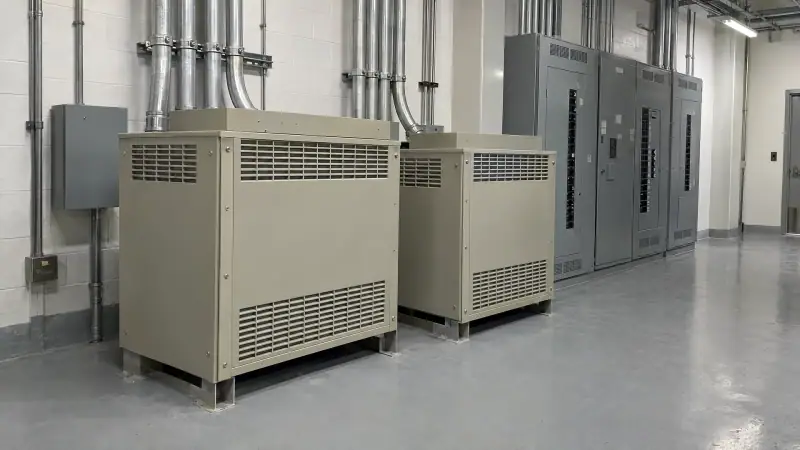
What the 80% Rule for Transformers Actually Means
The common rule of thumb is to keep a transformer's continuous load at or below about 80% of its nameplate kVA rating. That leaves capacity for load growth, changing operating conditions, and planning uncertainty. It is a design guideline, not a universal restriction on every electrical transformer.
A transformer may be designed to supply its full nameplate rating under the manufacturer's specified conditions. Ambient temperature, cooling, installation, and load characteristics affect that capability. Loading above the 80% guideline therefore does not, by itself, mean a transformer is overloaded; loading below it does not prove every installation condition is acceptable.
The transformer 80 percent rule also gets confused with continuous-load requirements for conductors and overcurrent protection. Those requirements concern the electrical circuit and its protective devices, not simply a percentage reduction applied to the transformer nameplate.
We use the nameplate rating when identifying a unit for purchase. Our transformer size information helps sellers distinguish rated capacity from the amount of load their facility actually uses.
How NEC Continuous-Load Sizing Relates to 80%
Under the NEC, a continuous load is generally one whose maximum current is expected to continue for three hours or more. For many applicable feeder and branch-circuit sizing situations, the calculation includes 125% of the continuous load plus 100% of the noncontinuous load. Specific provisions and exceptions depend on the circuit and equipment.
The familiar 80% relationship comes from the inverse of 125%: a continuous load equal to 80% of a device's rating becomes 100% when multiplied by 125%. This is why people often discuss the 80% guideline alongside standard breaker and conductor sizing.
However, you should not take a transformer's kVA rating, multiply it by 80%, and call the result an NEC-mandated capacity limit. Transformer overcurrent protection has its own requirements. Certain listed assemblies rated for operation at 100% also have applicable exceptions and installation conditions.
We recommend having the responsible electrical engineer or qualified electrical contractor confirm the adopted NEC edition and requirements for the installation. This is general educational information, not a code determination. Our other transformer seller guides address the separate questions involved in removing, documenting, and selling a unit.
Check Actual kVA Before Calling a Transformer Oversized
A low average load is not enough to establish that a transformer is oversized. An engineer should compare the nameplate rating with the facility's peak demand, sustained operating load, and expected future demand. A short snapshot taken during a quiet shift may miss the conditions that drove the original selection.
Useful records include:
- Nameplate photos showing kVA, primary and secondary voltages, phase, and cooling information.
- Metering or engineering records showing apparent power in kVA, not only real power in kW.
- Operating schedules identifying loads that run continuously.
- Information about motor starts, seasonal peaks, and planned equipment additions.
- Load balance and harmonic information where nonlinear loads are significant.
Power factor matters because kW and kVA are not interchangeable. On a three-phase system, uneven phase loading also deserves review; a total demand figure can hide a heavily loaded winding.
We do not decide that a unit should be removed based on a single load reading. Once your team has determined it is surplus, we review its equipment details as buyers of used transformers, rather than treating spare capacity as a defect.
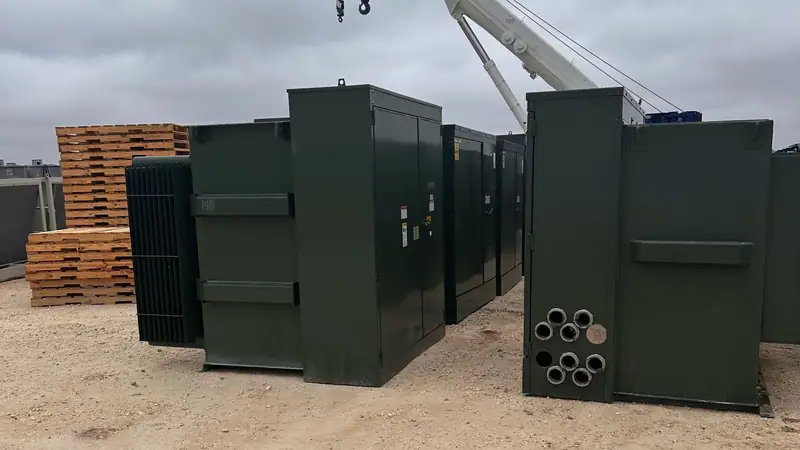
Cooling, Harmonics, and Temperature Affect Loading
The transformer loading rule is only a starting point. Heat is a major loading constraint, and the ability to remove that heat depends on the transformer design and its installation. Blocked ventilation, elevated room temperature, or a change in cooling equipment can reduce the operating margin even when demand stays unchanged.
For dry-type units, an engineer should check ventilation clearances, enclosure conditions, and the manufacturer's temperature-rise and ambient limits. Nonlinear loads can increase heating through harmonic currents, so ordinary load totals may not tell the whole story. A K-factor or drive-isolation design should be identified from its actual nameplate and documentation.
For oil-filled transformers, cooling arrangements, fluid condition, and available test records help explain service condition. Some larger units have different ratings for different cooling modes. Use the applicable nameplate rating rather than assuming the highest listed capacity applies under every operating condition.
When selling, describe known overheating, cooling failures, leaks, or damage directly. We buy damaged and failed units as well as serviceable equipment; clear condition information helps us evaluate the right purchase route.
Why Oversized Spares Become Surplus
A transformer selected with expansion capacity may become unnecessary when a project is reduced, equipment is relocated, or a facility changes its distribution system. A spare may also have the wrong voltage or configuration for the remaining equipment. In those cases, keeping more capacity does not solve the compatibility problem.
Capacity alone does not determine resale potential. We review kVA, voltages, phase, age, condition, fluid and PCB status, and test data when available. A lightly loaded unit still needs a condition review, while a unit that operated closer to its rating is not automatically a scrap transformer.
Our guide to what a used transformer is worth explains the equipment details that support an evaluation. Tell us if the unit is new in its crate, disconnected and stored, or still installed pending removal.
Confirm ownership before offering it for sale. A utility-owned transformer belongs to the utility, even if it sits on your property. Our transformer ownership and paperwork guide covers records to gather; fluid and PCB handling requirements should be confirmed with the appropriate qualified professionals before removal.
Send Us the Nameplate and Plan the Pickup
To start, call or text 951-403-5738, or use our online offer form. Send readable nameplate photos, overall photos, the New York pickup location, and a brief explanation of why the transformer is surplus. Include available load history or test reports, but you do not need to create an engineering study just to submit equipment for review.
We review the unit's type, rating, voltages, age, condition, fluid and PCB information, and any supporting records. We then provide a written offer. Our purchase evaluation is separate from an engineer's decision about what transformer your facility needs next.
Tell us about access, whether the unit is disconnected, and any known dimensions or weight. Use the nameplate or manufacturer documentation for weight rather than estimating from appearance. Our loading and shipping guide explains the information needed for transport planning.
We have no public New York storefront or drop-off yard. We coordinate pickup at your location, including rigging, forklift or crane needs, and appropriate trucking; you may load if you prefer. At pickup, we make a quick inspection to confirm the unit matches the photos. Payment is by check, ACH, or wire under the agreed terms.
Questions sellers ask about The 80% Rule
What is the 80% rule for transformers?
It is a common planning guideline that keeps continuous load at or below about 80% of a transformer's nameplate kVA rating. It leaves operating and expansion margin, but it is not a universal NEC limit on transformer capacity. We recommend checking manufacturer requirements and having an engineer review the actual load and installation.
Can a transformer run at 100% of its rating?
A transformer may supply its full nameplate rating under the manufacturer's specified operating conditions. Cooling mode, ambient temperature, ventilation, harmonics, and load balance matter. Running above the 80% planning guideline is not the same as exceeding the nameplate rating. We recommend an engineering review before changing a unit's operating load.
Does the NEC require transformers to be loaded only to 80%?
There is no blanket NEC requirement limiting every transformer to 80% of nameplate kVA. The commonly cited relationship comes from 125% sizing for continuous loads in applicable conductor and overcurrent-protection rules. Transformer protection requirements are separate. We recommend confirming the current adopted code and applicable exceptions with the responsible engineer or electrical contractor.
Can I sell a transformer that is oversized for my building?
Yes, we buy surplus transformers once you have confirmed that you own the equipment and no longer need it. Send nameplate and overall photos, its condition, and the pickup location. Extra capacity alone does not establish condition or value. Utility-owned transformers cannot be sold by the property owner.